
The "Ugh, I Look Terrible" Problem: An Introduction
We've all experienced that sinking feeling when we step into a room, catch a glimpse of ourselves in the mirror, and suddenly feel exhausted, pale, or just plain unattractive. It's not about our outfit or lack of sleep—it's the lighting. In a beauty salon, this can be a silent business killer. If your clients don't like what they see in the mirror while sitting in your chair, they won't appreciate the work your talented stylists are doing.
The solution isn't hidden in a warehouse of industrial fixtures; it lies in the "magic" of high-end bathroom vanity lighting. At Hidden Technology, my mission is to simplify the complex science of color and optics into clear, actionable strategies for salon owners. You shouldn't need a PhD to understand how lighting impacts your bottom line, but it is vital to grasp how it affects human emotions and your customers' biological responses.
The Vanity Secret: Why Vertical Lights Are Your Best Friend
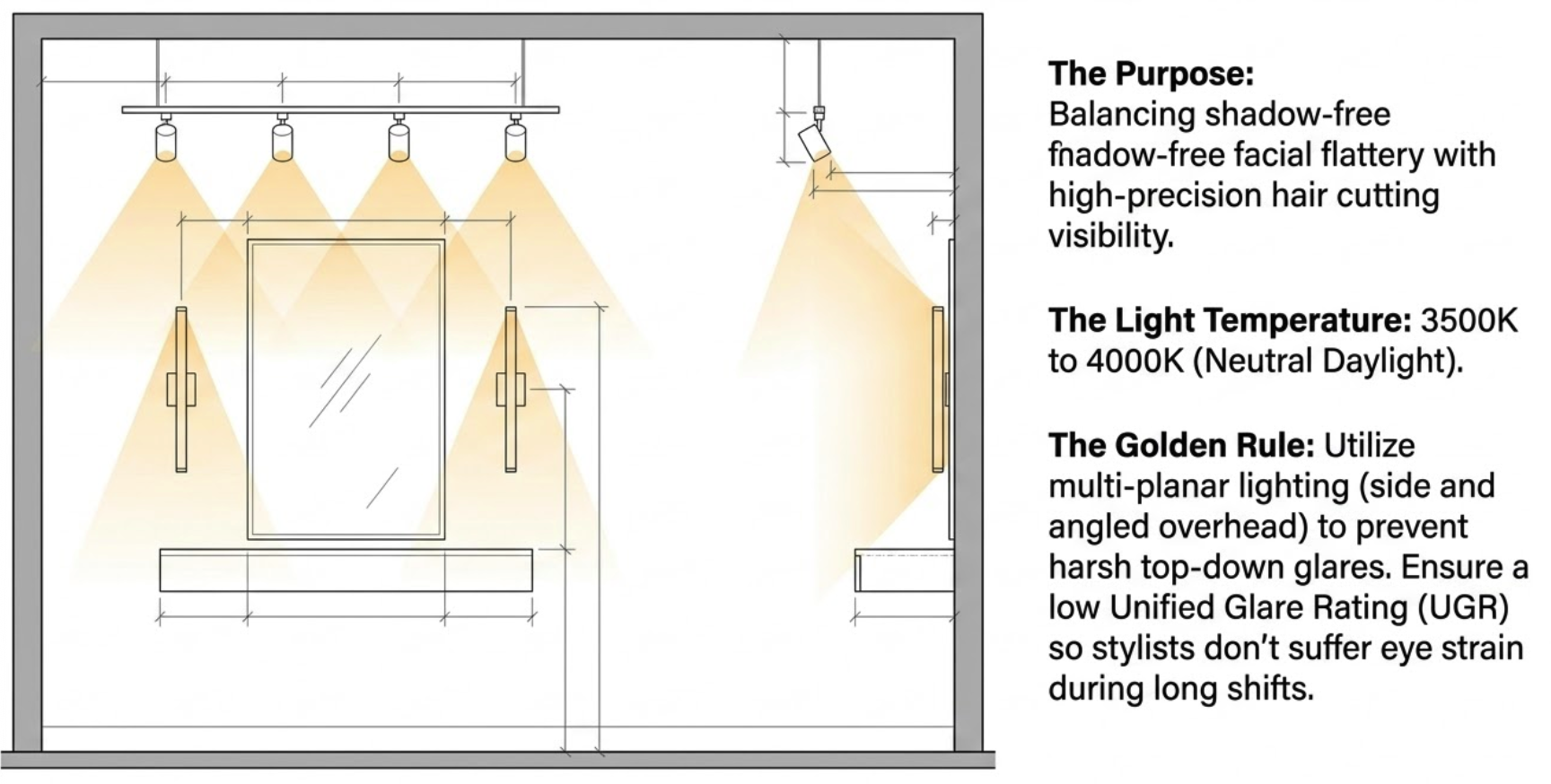
To eliminate harsh top-down shadows at the styling chair, combine vertical face-height side sconces with angled overhead task lights operating at 3500K–4000K neutral daylight. This multi-planar approach provides shadow-free facial flattery for clients while maintaining high-precision visibility and low glare (UGR) for stylists.
Many salons primarily use overhead lighting for its efficiency. However, lighting from directly above can create harsh downward shadows that accentuate imperfections under the eyes and chin, often making even the most youthful skin appear aged. To address this, we utilize a technique called "multi-planar lighting."
Multi-planar lighting involves positioning vertical light sources parallel to the mirror's edges, similar to a high-end bathroom vanity setup. This arrangement provides diffuse "fill light" that illuminates the face from the front rather than from above. By evenly distributing light across the facial contours, we effectively minimize unflattering lines.
When a client looks in the mirror and sees a radiant, shadow-free reflection, their confidence in the stylist's work increases dramatically. This creates a psychological connection: if the mirror reflects a positive image, the client instinctively trusts the transformation in progress.
Vertical light sources positioned along the edges of the mirror provide an even distribution of soft horizontal light across facial features, reducing harsh lines under the eyes and chin for a more youthful, radiant appearance.
The Magic Numbers: Why CRI and R9 Actually Matter
In the world of lighting, we assess quality using the Color Rendering Index (CRI) and its companion, R9 (Deep Red). To understand these concepts, imagine a box of crayons.
CRI is akin to the total number of crayons in the box. A high CRI (90+) indicates that the light has a broader range of "colors" available to showcase the true hues of your salon's interior and, most importantly, the hair.
R9 is like the specific "skin tone" crayon. It measures how effectively a light renders deep, saturated reds found in human skin and hair. Without a high R9 value, the light can strip the healthy red tones from a person's complexion, making them appear sallow or gray. This effect can lead to what's known as the "Auburn Hair Trap." If a stylist works under light with poor red rendering, an auburn dye may look like a dull brown. The stylist may then over-correct by adding too much pigment. The unfortunate result is that when the client steps outside, their hair may suddenly become an oversaturated, vibrant bright red because the salon lights have misled the stylist.
Additionally, R9 is crucial for nail technicians, as it allows them to assess skin health and examine cuticles accurately. This capability enables them to identify micro-abrasions and match subtle pink or red polish undertones with precision. Investing in high-performance lighting (CRI 90+ and R9 50+) is more than just an aesthetic choice; it acts as insurance against customer complaints and technical service errors. It also represents an investment in your staff's well-being, as high-quality optics reduce glare and eye strain, creating a healthier and more comfortable environment for your team to work in all day.
While these numbers are the current gold standard, the latest research, such as the TM30 metric, shows that our preference for "vivid" colors isn't merely a matter of taste; it is a scientifically measurable biological response. We have evolved to prefer light that makes colors pop.
Defining the Vibe: Why Your Salon Needs a "Bar in the Bar"
A modern salon is made up of various "zones," and lighting is the best tool for creating boundaries without walls. It's essential to differentiate between functional areas and aesthetic areas.
Imagine a "nail bar" situated within a social or lounge setting. In the social area, the goal is to make customers feel relaxed and engaged. The lighting here should have an "amber, low-contrast glow," which creates a warm, inviting atmosphere. However, as customers move to the manicure station, the lighting should shift to "surgical precision." In this area, the light becomes bright and crisp, allowing the technician to see every detail of the nail and skin.
By clearly defining these zones, your customers will navigate the space more intuitively. They will know where to relax and where to focus, as the lighting guides their mood and experience.
The Power of Layering: How Light Sells for You
Great lighting is not just about using a single fixture; it's about "layering." This involves combining ambient overhead lights with task-specific vertical mirror lights. Layering adds depth and makes your salon feel more like a premium destination rather than a clinical environment.
This high-quality, layered approach has a specific benefit for your bottom line: it encourages "social proof." When people look and feel beautiful in your salon, they are much more likely to take photos and share their experiences on social media. This creates an atmosphere that customers don't want to leave, naturally boosting sales and increasing repeat bookings. By prioritizing lighting that appeals to our innate instincts for beauty and vividness, you allow your salon's architecture to promote your services effectively.
Your New Luminous Blueprint: A Forward-Looking Summary
The lighting industry is evolving from simply making a room "bright enough to see" to designing lighting tailored to people. High-end lighting is a precision tool that ensures color accuracy, protects your stylists' vision, and uses "bathroom magic"—that multi-planar, vertical light—to make sure every client feels like a star.
At Hidden Technology, I aim to help you envision your building in a new light. By prioritizing the science of how light interacts with the human face, you are not just decorating; you are optimizing your business for greater success.
Final Thought:
When your client looks in the mirror today, are they seeing the best version of themselves, or just the shadows on your ceiling?